Thursday, 16 April 2015

The Afternoon Movie - The Secret of NIMH


 Continuing very slowly my adaptation theme, I thought it had been quite a few months since the last 'Afternoon Movie' post and that it was high time for another. 

Perfect for those lazy weekends or indeed afternoons. The 1982 Don Bluth classic, 'The Secret of NIMH', based on the book 'Mrs Frisby and the Rats of NIMH' was one of those film we had on VHS. My sister and I loved it. I always remember quoting and so did my family, 'Move your house, to the lean of the stone.' Seems random and out of context for those who haven't enjoyed it yet, I apologise for this.

The story is about a field mouse, Mrs Brisby (changed from Frisby) who's husband, Jonathan has recently died. She seeks help from a fellow mouse, Mr Ages, as her youngest son is sick and cannot move from bed. To make matters worse, 'moving day' is upon her family and all the other animals tha live in the fields of the farm. This means the farmer is going to plow the fields with a tractor and will wreck the inhabitants homes. Desperate for a solution, Mrs Brisby, braves a visit to the 'Great Owl' with the help from her friend, Jeremy the clumsy crow. The owl only offers advise after finding out she is Jonathan's widow. He tells her to seek help from the rats that live in the rose bush in the farmers garden. At first the rats do not want to help but eventually agree to move the Brisby home to safety, again, only because of Jonathan. Mrs Brisby finds out that Jonathan, along with the rats all came from NIMH, where they were experimented on. The treatment and torture resulted in them becoming intelligent, almost to the level of a human. The rats, lead by the wise old Nicodemus, have devised a plan to escape the farm and start a colony elsewhere, but Jenner, an angry violent rat, opposes this idea and plans to kill Nicodemus to push his own agenda. There is a showdown between rats during the moving of the Brisby home, putting the family in danger.

Trying not to spoil the ending, there is also a weird supernatural element to the story involving a magic red stone that can cause miracles, but I really want those who haven't seen it to enjoy an air of mystery.

The book was written by Robert C O'Brien in 1972 and was inspired by research about mice and rats dynamics at The National Institute of Mental Health (NIMH) from the 40's to the 60's. I read the book while at secondary school and at first, I didn't like it, I was too used to the animated film. But as we, the class, got through it, I ultimately preferred the book. The change of names aside, the true story is still there. The horror of what happened to the mice and rats in lab is carried across in the film as well as the danger of the plow for all the animals. But the weird, some what uncomfortable super stone side element is not in the book, and the story has more focus because of it. But, it is such a small part of the whole plot, it might not bother others as it did me.

Apart from the Don Bluth classic touch to this film, the animation isn't too bad for the 80s (outside of Disney). The story has a strong female lead, Mrs Brisby, who is literally willing to do absolutely anything to not get her child out of bed to save her family, especially her sick son, Timothy. It was also a great background story that may seem like it overshadows the present story, but when Nicodemus relates how they escaped from NIMH is actually one of the best sequences in the film. It also highlight blatant animal cruelty and the effects of humans interfering with nature to help themselves. That might be a bit too deep.

While watching it recently, I began to take in the shock and absolute horror that the film presents. For the farmer, its just a small chore, plowing the back field but for all the animals, it means danger, having to evacuate and literally run for their lives, just as Aunty Shrew yells. The animals are terrified, these feeling were not as clear to me when I was younger, I just animals worried, running away, that's it. Mrs Brisby definitely goes through at least 5 traumas a day from flying on a crow, meeting an owl that might eat her to confronting violent rats who love electricity.

If you are a fan of the film, I would recommend the book, just to see the differences. I would suggest that you steer clear of the direct to video sequel, 'The Secret of NIMH 2: Timmy to the rescue'. The disturbing poster is enough to put you off as well as the fact Don Bluth had nothing to do with it.

The film is out there to buy on DVD, watch on youtube and I think I've seen a VHS copy floating around some charity shop too. Delve into the small world of mice, rats and a secret that isn't really a secret, you won't regret it.


Part of the Madding Crowd

Breaking from tradition and before this gets too strange, I'll relate a series of events. Obviously, they all connected to film.

Last week I entered and won a competition on Facebook from the film's page. It was to win tickets to a Gala Screening of 'Far From the Madding Crowd'. To enter, you had to send in a photograph of the countryside you had taken. I sent this:


To be honest, I'm not a lucky person and I don't win things (usually), not by luck anyway. This, was by luck. I didn't expect to win. I took the photograph a few years back, it is a view from Corfe Castle in Dorset and it won me a pair of tickets. Unfortunately, the Gala Screening is in Bridport, Dorset and is actually tomorrow (17th). I managed to swap days at work so I could go, but due to the long distance, my lack of transport and nowhere to stay that was affordable, I had to bow out.

I was really annoyed. I had started planning trains to get there, looking desperately for accommodation but alas it wasn't meant to be. I would go far for a film but I can't for a 4 hour journey. I actually really sad that I couldn't go. Sorry to get all melodramatic.

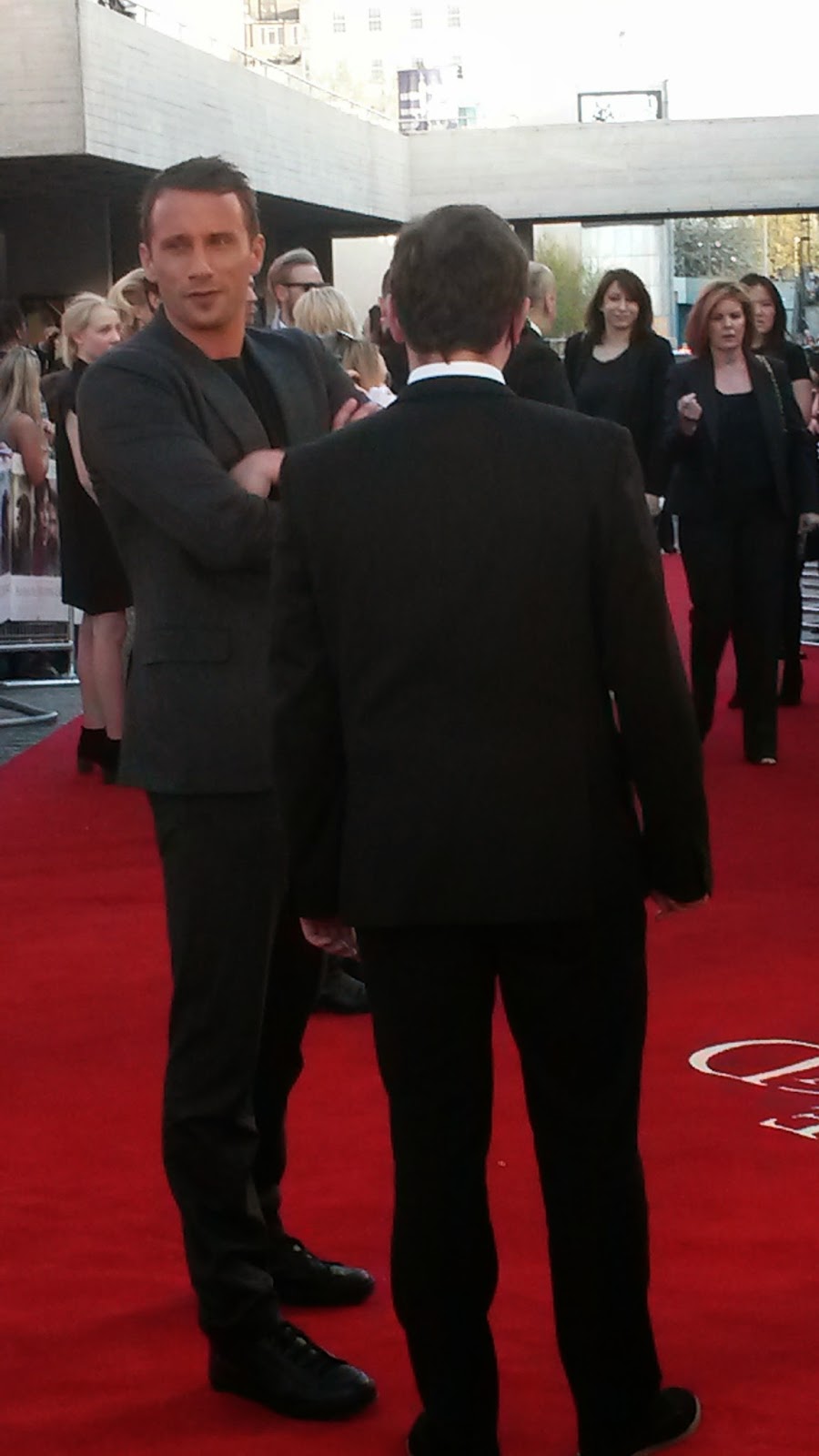
I found out on Facebook that the World Premiere was to be at BFI Southbank (favourite place). Luckily I finished early from work so headed down to the river. I almost fell asleep on a bench, tried to eat a bagel and drank the world's smallest latte. I got a space at the front next to two fans of Matthias Schoenaerts and thought, 'I'm in good company here'.

It started to get a little bit crowded but not Leicester Square crowded, people could still walk around with ease without the fear of being squished by watchers and fans. I was very excited about this film, not only because of the cast or the fact that Thomas Vinterberg directed, but also, its a British film and it's kind of a big deal. An adaptation of Thomas Hardy's classic, costume drama, British film's bread and butter.


Anyway, back to the red carpet. I managed to get a few decent photographs, be blinded (and overwhelmed) by the photographers, all crowded into a small space opposite from where I was. I managed to get this gem:


We have our friend in the middle there, most likely making this one of the most awkward selfie red carpet photos ever?  Carey Mulligan is a great sport, she went round to all the fans, signing things from photos to scraps of paper to bags.

After posting the photo on Instagram (like you do) I was told to look at The Daily Telegraph the next morning. This is what I found.


 Not only did I make it into some videos of the event, but I appeared in some newspapers online and print. I think this might be a rare occasion, making the front page of The Daily Telegraph.

Of course the first thing I did was burst out laughing, then show my friend at work, send a link to my friends who were at the premiere with me, and my family. All had the correct response, laughing, because its so bizarre. But it is a great photo.

I take away from this last week, that I won a competition, but didn't get to reap the rewards (which I am still really gutted about) but I got to be at the front for a premiere of a film I've been waiting for  ages to see and I was on the front of a national newspaper. Pretty good week I suppose. Now I'm REALLY geared up for the film, which is out on May 1st.


Wednesday, 8 April 2015

Seen the Film, Read the Book

I am quite proud that there aren't many films where I have watched the film first then read the book it was based on. I usually try to read the book before or, most of the time, watch the film and cannot read the book after.

This is the list of film adaptations where I watched the film first, then read the book.

1. Pride and Prejudice

 The Jane Austen classic about the Bennett family, particularly about Elizabeth and her relationship with the infamous Mr Darcy. I had seen both beloved classic TV series and seen Joe Wright's beautiful film. I later bought the book for 20p at a random charity shop or it might have been a summer fete and read it, then become bored half way through and decide the audio book would suit me better. I think, any form of adaptation of this novel is winner, except that it is remade to death.

2. Little Children

 A story about suburban women and men trying to live out their seemingly boring lives during a summer. From the breakdown of marriages and adultery to the neighbourhood watch and pedophiles returning home. By Tom Perrotta, who has the amazing ability to take something mundane and make it incredibly hard to put down. The film concentrated heavily on the affiar between a stay at home Dad and a reluctant mother, as well as the recently released pedophile back into the neighbourhood. The film is good but the book is by far much better. A character that appears for seconds in the film is actually one of the four main ones in the book and her balance is quite important. The ending is also more relaxed in the book too, shocking truths are told but no one reacts and perfect.

3. The Curious Case of Benjamin Button

 The film about a man ages backwards, with the source material being a short story by F. Scott Fitzgerald directed by David Fincher, had everyone excited. The first time I saw the film I loved it, I thought it was long but brilliant. Then I bought it on DVD hoping to relive the magic, but what followed was me realising the film was too long to be enjoyed and the characters were annoying. The story is brilliant. Perfectly detailing the life of Benjamin Button in a mere 28 pages. After reading the short story I couldn't watch the film again I was so disappointed. There was nothing wrong with the original story, there was no need for a whole change. In fact the only element from the story was the name, Benjamin Button and that he ages backwards, everything else is made up.

4. The Princess Bride

 When I first saw the film classic about true love, Princess Buttercup and Wesley, I didn't know what to make of it. With further viewings, the words 'As you wish' rang in my head and I understand the appeal of this slightly bizarre fairytale. I had no idea there was novel before the film. The Princess Bride I have to thank as it not only got me back into reading since I was in primary school, but actually got me buying books again. While in secondary school I read all the books we were meant to, apart from Wuthering Heights, that was dull, and I had stopped reading books other than Lord of the Rings and A Series of Unfortunate Events. I bought the book while at college and was hooked. The book was just like the film for me, it was well adapted and there were scenes in the book but not in the film, it felt like the directors cut.


5. Suite Francaise

 As I mentioned in my March Watch List, I was/am obsessed with this story set in France 1940, in a small town outside Paris when a German regiment arrives. An officer is billeted with Lucille and her cold Mother-in-law. At first a forbidden attraction, then love blossoms between the German and Lucille but there are bigger issues happening in the town and country. The film was beautiful, the lead characters so painfully subtle in their affection, the ending was just so vexing. The book or books I should say were different. I wanted to read it in the hope that there was more not included in the film. I read 'Dolce' but not 'Storm in June'. I was rather upset with book by the end as it was more unsatisfying an end than the film. Where both have merits, they both have tragic ends that are not really concluded. 
 
6. Gormenghast
 
 How to even begin describing Gormenghast? I actually only read 'Titus Groan', the first in the trilogy. The second book is called 'Gormenghast', as was the BBC TV series. I actually chose my 'Confirmation' name as Titus because of this story. The amazing fantastical world of Gormenghast, a great castle ruled over by the Groan family was created by Mervyn Peake. The story begins with the birth of Titus, heir to Lord Groan. This birth coincides with Steer Pike's rise from kitchen rat to a member of the elite, secretary to the Groan family. I was obsessed with the TV series when it first aired. I used to watch it over and over when we recorded it. It was such a bizarre world, all within the walls of a castle. The story and most of the characters were dark, this is probably why I enjoyed it, and it was fantasy that didn't have any mythical creatures and didn't seem to be set at a specific time or place, it was new and brilliantly created. My aunt and my mum actually really love the books and warned me how dense the books were. I got through Titus Groan, eventually, and they were not kidding. The descriptions for places, rooms and scenes were vast and I have to say, if you're planning on reading the books, be patient, the pay off is worth it. One day I might try and read the next two, Gormenghast and Titus Alone, one day.

Wednesday, 1 April 2015

Blind Spot Series - Touch of Evil

I have had 'Touch of Evil' sitting on shelf since I was still in college. I remember my film studies teacher telling me about film noir and this spurred me on to find more films to watch. I bought it, got excited about, got distracted by other film noir films (feels silly writing that) and its just been sitting on my shelf for 7 years.

'Touch of Evil', heralded as one of Orson Welles best films and as of the greatest thrillers, before seeing it I knew three things which it is famous for:

1. The opening tracking shot, no cuts for 3 minutes 20 seconds. Many other films have paid homage to this
2. Charton Heston plays a Mexican police officer - let that sink in
3. The various cuts of the film, especially the cuts that Welles originally wanted

The story is about corruption and has the usual Film Noir traits. Ramon Vargas (Charlton Heston), big-time police officer on Mexico City is on his honeymoon with his American wife Susan (Janet Leigh) near the border of USA and Mexico. A bomb is planted in a well known man's vehicle, he and his passenger are killed in the explosion. The detective in charge of the case is Hank Quinlan (Orson Welles), who conducts his investigation in a questionable manner. While Vargas takes an interest in the case, especially after he believes that Quilan has planted damning evidence on a suspect, he sends to wife to a safe place. She had been harassed by the member of the Grandi family drug gang, a member of which was facing a trial, Vargas being the arresting officer. Quilan soon becomes even more obsessed with Vargas getting in the way and concludes withe Grandi family to get rid of the interfering Vargas.

The plot does get thicker and it ends up moving faster but there are a few moments where it borders on the slightly ridiculous, and I don't mean trying to swallow Heston as Mexican. One particular moment is when Susan Vargas, hold up in a strangely remote motel is being surrounded by Grandi gang members, both men and women and loud music is blaring out loud. It is actually terrifying, that is until the music is suddenly turned off by the old motel manager. The gang members loose their menacing flow and start to look silly. Later on its explained that the gang drugged her up and took her clothes.

I love Film Noir, I will usually eat up most stories involving a detective, a murder and femme fatale to boot but there was something odd about the story and shift of focus on what was really important. It felt that the bomb that went off at the very beginning was a trigger but was actually just a very elaborate meet-cue for Vargas and Quinlan. The investigation into who planted the bomb seem to be solved within a few hours and was just a MacGuffin. The real story was about the corrupt Quinlan and exposing him while he gets drunk and makes even more bad decisions.

 My qualms about the story aside, there are some amazing shot in the film to admire and the choices actually make the film better for it. Welles used so many overhead shots intense conversations which would usually distract from the dialogue but they are used to brilliant perfection and in the right place. I admire Welles mostly for his direction on the film and less so his character as he tended to mumble quite a bit. The film is given a lift to intrigue from the start as the first shot is a bomb and the unknown planting it in a car, again unknown. The shot tracks the car then follows Heston and Leigh, while the car is still in the background or to the side. The audience is introduced to characters while still being drawn into the story as they know the car will explode any moment. The film's pace continues in this way often cutting between slow moments and action and it keeps the film rolling and doesn't feel like 90 minutes.

 I'll spare a moment for the world's most irritating character though, the night manager of the motel where Susan stays, played by Dennis Weaver.  This character made me so angry every time he was on screen. He did absolutely nothing to help the plot after twitch his way through a few scenes refusing to do anything that sounded like his job. I really wanted someone to just get him out of the picture.

I do feel that I waited too long to see the film as I think if I has seen it years ago, I would have been bowled over by the edit alone but now you really need a story that makes sense for me to fall in love with it.

Don't forget to check all the other Blind Spot Series entries and where it all started on The Matinee


Thursday, 26 March 2015

March Watch List

1. Chappie


I've seen mixed reviewed for this film about A.I and child development and I'm surprised. I thought this film was brilliantly executed. On the surface, its about a creator and his creation and how people can corrupt an innocent for their own gains. Then there is a deeper message, is a child corrupted by its family and the people it associates with or is it just circumstantial, the environment. To bring down crime in Johannesburg, the police are made up of human offices and robotic humanoids. The success of the robot offices brings success to Tetravaal, a weapons manufacturer and the creator, Deon. Deon then creates artificial intelligence giving a robot emotions and he ability to form opinions but after he is kidnapped by a street gang who forces him to 'wake the robot up' so they can use it to assist in their crimes. Chappie is born. Sharlto Copely plays Chappie, voice and motion capture too, and he is brilliant as well as being the director Neil Blomkamp's favourite having appeared in his last two features.  There is heart in his film as well the enjoyment of seeing corruption of innocence seen through the eyes of a child/robot. There have been talk of a sequel which would be a shame as this film and story stands well alone. I should also mention that Hugh Jackman, as the ex-solider turned weapon designer is quite good as the weird villain who wants man operated machines on the streets instead. He is so far removed from the typical muscle crazed hero its delightfully refreshing. With a mixture of non actors and professionals, the characters gel surprisingly well together, on screen at least. 4/5

2. Fifty Shades of Grey

Let's be clear, I've not read the book, nor will I ever read the book but I saw the film because I thought, if I'm going to make fun of this film or criticize it in any way, I should at least watch it. My opinion at the end, it is neither great nor bad. I can understand fans of the books would be annoyed by a few things, namely the fact that the book is explicit (so I'm told) and the film barely breaks the 15 certificate. The filmmakers had the opportunity to go all out and they didn't. The hype around the book has been tamed down that it becomes more about the relationship that the s&m scenes. The relationship is also annoying but that is a character fault not the actors. Ana and Christian are the main focus of the film, the supporting characters who appear every now and then are used with small effect, they do not move the story along, all the work is left on the leads shoulders and their up and down relationship, will be sorted out in the sequels. This film very much felt like a long intro. But saying all this, the two leads had chemistry at least. 2/5


Seals, folktales and beautiful 2D animation, of course this film was aimed at someone like me. The story is about Ben and his sister Saoirse and their father, the lighthouse keeper. After the death of his mother, who died presumbly during childbirth, Ben has always been hostile towards his younger sister who at age 6 has still never spoken a word. But when Saoirse discovers a white coat and lead to the sea by mystical fairy lights, there she discovers, after wearing the coat, she is a Selkie. After being discovered on the sea shore the next morning, the children's visiting grandmother insists the children live with her in the city. The defiant Ben decides to escape and make his way back home with Saoirse in tow. They journey home and discover and meet fairies of the myth and legend as well Saoirse's destiny and importance between worlds. Its beautifully animated and the story, so simple yet brings out all emotions. The seal and folklore aspects just the film all that more enjoyable to watch. 4/5


4.  Suite Française 


My friend and I went to see it like it was like any other war drama, but after the first viewing we were hooked. The film's end felt like we were left in suspension and for me disbelief that it ended. Again, I've read mixed reviews about this film, centered around the German occupation of France in 1940. A regiment is sent to a town outside Paris and how the residents and he soldiers live along side each other. We became obsessed with this film and story, as we both read the book the film is based on by Irene Nemirovsky, who was writing the novel just before she was taken to a labor camp for being Jewish. The film is heartbreaking above all but it was also interesting to see a different aspect to the war. Set just when Germany defeats France and takes over, the Germans are the enemy but are seen to be civil until one of their own is murdered. Along side the main story of occupation, there is a romantic element. A German officer, Bruno is billeted with Lucille and her stern mother in law, Madam Angellier. Her son is a POW and she treats her tenants with contempt. Bruno and Lucille share a bond through their love of music but it is, as always, an ill fated romance. Played with such subtly by Michelle Williams and Matthias Schoenaerts, the relationship is not sweet but delicate and works so well on screen, just wish they had longer scenes. The story's outcome and the outcome for several of the characters featured in the film is changed and ultimately damned by one selfish person. From this point on the story descends into the usual, way a war film does, its frustrating but not disappointing. By my friend and I reading the book, we searched for answers to see if we missed something. We both felt that the romance needed further attention and I personally felt the sting of the ending. I don't wish this often or ever, but I hoped for a change of ending from the book. And no matter how many times I watch, love, despair at the film, it will never change. Directed by Saul Dibb with the elegant touch that he previously had in The Duchess, I should have know I would have been depressed with the end. If you're wondering about the title, it is the name of the music that Bruno is composing throughout the film. 4/5

5. Seventh Son


I'm sorry but I gave this the lowest possible score as it didn't even hold my attention. The myth behind the story is far more interesting than the actual film. It's not a surprise that this film is based on series of books. I think the studio who made it was hoping for a franchise to bloom but I really can't see it. It will most likely go the way of Cirque du Freak: The Vampire's Assistant, The Dark is Rising, Vampire Academy and Eragon, all based on book series aimed at young readers and tweens. None of them got a sequel. Dystopian adventures seem to hold the winning formula but those are also running short. The Seventh Son was bland and not even Jeff Bridges playing Jeff Bridges could save this film. Plot, young man destined to save the world from darkness and a powerful witch becomes to the apprentice to a Jeff Bridges who is a 'Spook' someone who can vanquish evil things. That's the premise and I'm sure you can all predict the end. Oh, and they make sure to leave room, just in case a sequel is made. 1/5

6. Zero Motivation


After seeing the trailer on Apple trailer, this was during festival season, I was hooked. A comedy about women during military service, perfect. But where the trailer made the fill look purely like a black comedy, the film was more about friendship and the comedy was slightly thin on the ground. The film is split into 3 chapters, 'The Replacement, The Virgin and The Commander'. Each section follow the day to day life at the military base of the women, mainly, who non-combatants, working the admin office. Zoar, is on the surface lazy and refuses to make an effort and Daffi just really wants to leave the base for another in a better location. I did laugh at some of the mishaps and the scene where the entire office is stuffed full of shredded paper but otherwise there are some quite disturbing stories within the base, one involving a suicide and one of the women being possessed by a ghost. I would reccomend the film but be aware its not an outright comedy. 3/5

Saturday, 14 March 2015

Mothers, Monsters and Mayhem

It has forever been a bother for me when stories are trying to find something or someone for the audience to 'connect' to and they end up going for the same old boring thing, single mother with a sick child. It's incredibly disappointing.

I appreciate stories between mothers and sons/daughters but when its part of the story not as a lame add on. There are films that have the 'mother figure' or the 'mother presence' that is usually needed as part of the main character surrounding supporting characters, especially if its a family drama or someone who is returning home.


 But, more often, the 'Mother' character is one of two beings. Someone who is domineering, maybe even violent, she causes misery, sometimes for comic effect. The other role the 'Mother' plays is the absent parent, events in the story are in her name or her absence is the cause for the events and certain characters behaviour.

A few films are based around a very generic relationship between a mother and a child, for example in 'Anywhere But Here'. Adele (Susan Sarandon) up roots her daughter, Ann (Natalie Portman), to LA in order to better themselves.  Ann can't stand her Mother and says this all the way through even though at times she won't go anywhere without her.

In a twisted way, the relationship in Watchmen between Sally and Laurie is similar. Even though, Sally forced her daughter to become Silk Spectre 2, dressing her up in provocative clothes, forcing her to take up the mantle and refusing to tell her about her real father, Laurie still visits her mother all the time, even going through the transporting which makes her ill. Her mother stole her childhood but she still feels like she needs her mother and Sally definitely still needs her.

There are plenty of horror stories that play on the 'violent, evil' Mother character. One that comes to mind is Carrie. I haven't actually seen the film but because it's an adaptation of Stephen King's novel, there has been so much coverage of it especially with the less successful remake. Carrie's mother is a religious fanatic who tortures her daughter mentally and physically to the point where Carrie breaks. That's just putting it gently. 


 Sometimes its the bond between mother and usually son that is too close and strong that causes the most damage. The prime example here is 'Psycho', Norman Bates (SPOILER) has a disturbingly close relationship with his mother to the point he dressed up in her clothes and murdered people, he even spoke in her voice. For me, that last scene where he is sitting in the cell, is the most disturbing. The TV series, Bates Motel, has run with this relationship, but set in modern day. It shows the lead up to the events that will eventually be 'Psycho', Norman's breaking point.


The horror and the shame the way mothers behave can have a terrible outcome and mothers who have been thought to be caring and loving are actually selfish and delusional. 'Flowers in the Attic' demonstrates the reverse nurturing effect when mothers become consumed with themselves and try to ignore their children as they are 'getting in the way of their happiness'.  Heather Graham played Corrine, seen at first as a loving mother until her husband dies and she's forced to move back home. But in order to stay in her father's good side, she hides her 4 children in the attic, where they remain for years. She barely visits them after a few months, intent on starting a new life. This entire ordeal completely damages the children in different ways mentally and physically, scaring them for life. There is also another mother daughter story between Corrine and her own mother, Olivia. Olivia had always been jealous of the relationship between her daughter and husband and she takes it out on her grandchildren.

The jealous mother character is usually for step mothers but like 'Flowers in the Attic', in 'Stoker', Evelyn (Nicole Kidman) is very jealous of her daughter, the slightly strange, quiet, India (Mia Wasikowska). At first it seems she was jealous of the father daughter relationship, she mentions to the uncle, Charlie (Matthew Goode), that they used to do everything together and exclude her. She is bitter about this, especially after the mysterious death of her husband. Charlie, the brother, is also fascinated by India and in turn India seems to have a connection to Charlie. Evelyn then tries to take Charlie's attention away, the only way a woman can, supposedly. But Charlie has other issues which is why he is connected to India, so for Evelyn, this attempt at making her own daughter jealous will ultimately fail.

The mean mother character can be comedic or incredibly serious, but sometimes a serious problem of bullying can create a comedy classic. 'Throw Mamma From The Train' is more about writers and a strange remake of 'Strangers on the Train', but the fact that a mother character comes into the story is important and shows just how strong a hold 'bad' mothers have on their suffering children. Owen (Danny DeVito) wants to be a writer but his overbearing beast of a mother is stopping him progress is every way. He convinces his teacher, Larry (Billy Crystal) to 'criss-cross' their murders, as Larry wants rid of his evil thieving ex-wife. As I said its not really about the relationship but its interesting to see a serious issue played out in a comedic way. The ending is hilarious by the way.

Mothers have a great influence over us and in films, as I said so many films are done in 'name of' our Mothers, particularly revenge films, like 'Four Brothers' that was actually pretty darn good. Its based on the The Sons of Katie Elder'. The four brothers seek justice when they're mother is murdered. This the 'absent' mother character, like a ghost who comes back to haunt the characters we see, sometimes never mentioned but we can all feel the presence.

This feeling can be applied to those mother characters that are no longer mothers. 'All About My Mother' is about Manuela who after her teenage son is killed, is left alone and decides to go back to Barcelona to look for the father. Its an heart-breaking start, but even though her son is gone, he still echoes throughout the film, so she never actually stops being a mother.

The 'over protective' mother type is often seen is quiet dramas, where the mothers don't want their children to fall off the rails but this usually has back lashes, particularly in 'The Virgin Suicides'. Kathleen Turner's character is positive she is doing the right thing when it is completely wrong, and her behaviour and rules may have contributed to her daughters desperate needs to 'get out'. Over protective 'action' mums can also 'get it wrong'. In 'Terminator: Judgement Day', Sarah Connor is locked up in a mental hospital while her son is looked after by foster parents. When she escapes, she is very 'motherly' but she has the instinct to protect. The need and want to protect the child can be a double edged sword, trying to do good may lead to downfall, but doing nothing can lead to resentment, its difficult to determine, in each film if its the mother or the child.

To wrap up on a happier note, the 'mum' character type in teen comedies is always fun to watch. They are usually uptight, rule making generics, a waste of space or hardworking and never at home. The ones that stand out and break these moulds are Mrs George (Amy Poehler) and Rosemary Penderghast (Patricia Clarkson) from 'Mean Girls' and 'Easy A'. To be honest these two films break the teen movie mould anyway. Mrse George is ridiculous, she is always taking photos of the back of her daughter's head and she doesn't really monitor what her younger daughter watches BUT she also encourages her daughter, be in a weird way. She comes to see her show, she brings drinks and snack for daughters friends and she doesn't really approve of the teens drinking. She's crazy but sometimes responsible and seems utterly oblivious to the fact her daughter is a bitch as she seems to love her no matter what.

Rosemary Penderghast seems easy going and like Dill, her husband, get along with their children, having very easy conversations about anything, even their sexual history. Rosemary, again, like Mrs George, seems oblivious to the rumours about her daughter. She trusts her daughter and doesn't pry into her life and is able to make funny jokes about 'gentlemen callers'. It's a very easy going relationship with her daughter, Olive and its not often that you see this on screen AND it feels completely believable this happens.


My last mention on mothers has to be about the ultimate mother-daughter relationship, Gilmore Girls. I could write a whole essay on this example alone. Lorelai Gilmore is a best friend to her daughter and mother. She knows when to draw the line and teach her daughter what she needs to know while giving her space and time to make up her own decisions. She is supportive in (nearly) everything Rory does. The circumstances that created this close bond come from another mother-daughter relationship. Lorelai and her mother Emily didn't get along because she was the opposite to what Lorelai is for Rory. She forced her into things she didn't want, she didn't support her in the way she needed, resulting in Lorelai literally running away to be free. I know some people are Gilmore fans, I know my sister hates it, but it is one the best examples for the mother character to be explored, there are 7 brilliant seasons to discover what I mean, and this isn't even 1% of what I'm trying to convey here. To press this further, both Lorelai and Emily could be examples of most of the 'mother' types at some point during the TV show. But, that will have to do as I have rambled on for a very long while.


I know there are a dozen more 'mother' types out there but the ones mentioned here are the ones that came to mind. If you have any more to contribute, please do leave a comment below, I'm always happy to read.

Happy Mother's Day!

Films mentioned; Anywhere But Here (1999), Watchmen (comic/film), Carrie (1976), The Sons of Katie Elder (1965), Four Brothers (2005), Psycho (1960), Flowers in the Attic (2014), Stoker (2013), Throw Momma From The Train (1987), All About My Mother (1999), The Virgin Suicides (1999), Terminator 2: Judgement Day (1991), Mean Girls (2004), Easy A (2010), Gilmore Girls (2000-2007)